
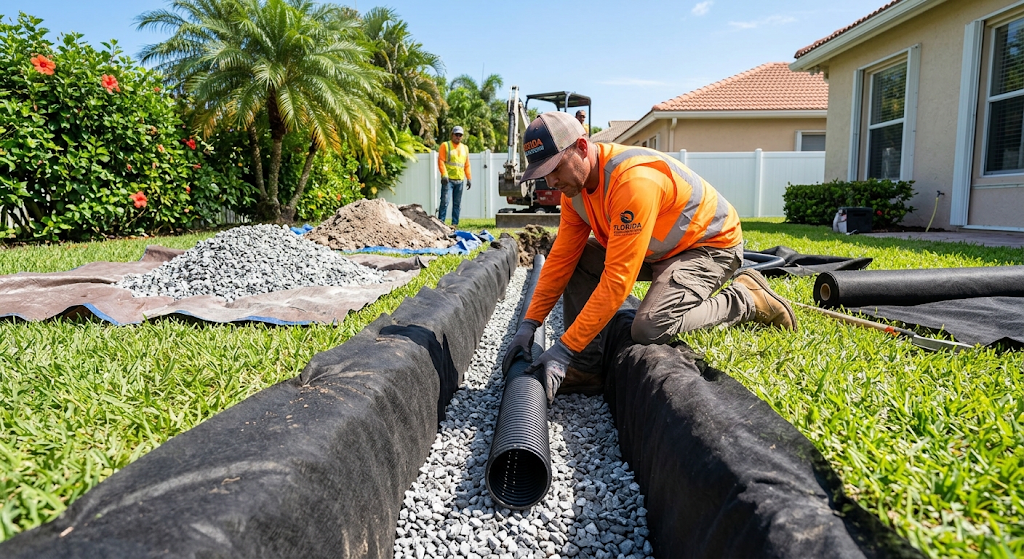
If you spend any time browsing local Florida home improvement subreddits, you will find plenty of frustrated property owners complaining about standing water pooling right outside their back doors. When local homeowners start looking into yard drainage St. Augustine solutions, one of the most common questions on community forums is how deep they actually need to dig their trenches.
People often assume that deeper is always better, figuring a four-foot-deep trench will swallow up all the standing water. But when you are dealing with coastal Northeast Florida’s unique soil composition and high water table, digging too deep can actually backfire entirely.
When planning professional French drain installation St. Augustine contractors look closely at your lot grading, turf type, and sub-surface moisture levels rather than just pulling out a shovel and guessing. Most residential gravel trenches in our area range between 12 to 24 inches deep, depending on whether you are intercepting surface sheet flow or managing sub-surface saturation.
Managing Sandy Soil Stability and Trench Depth
Unlike regions with heavy clay that holds water right at the surface, St. Augustine lots are dominated by sandy, loose soils. If you dig an overly deep trench without proper shoring or geotextile lining, the sandy sidewalls will cave in before you even lay your perforated pipe.
Key factors that determine your correct installation depth include:
- Surface Runoff vs. Saturation: Shallow 12-inch trenches work best for catching surface sheet flow off patios, while deeper 18 to 24-inch beds intercept rising ground saturation.
- Positive Outfall Slope: Every trench needs a downward drop of about one inch for every eight to ten feet of run to ensure gravity pushes water away effectively.
- Avoiding the Water Table: Digging past the local saturation line means your trench will fill up with groundwater rather than drawing water away from your lawn.
Protecting Your Turf and Foundation From Pooling Water
Getting the trench depth right ensures that stormwater flows safely away from your stem walls without turning your yard into a muddy sinkhole. Working with local site pros takes the guesswork out of grading. Learn more about Will A French Drain Stop My Yard From Flooding After Every Storm
Frequently Asked Questions
Should I line my French drain trench with fabric in sandy soil?
Yes. Wrapping the gravel trench and perforated pipe in a non-woven geotextile fabric is essential in sandy coastal soils to keep fine sand grains from silting up and clogging the system.
Can a shallow French drain handle heavy tropical downpours?
Yes, as long as the trench width, stone volume, and downspout or outfall discharge points are correctly calculated to handle peak rainfall volumes.