
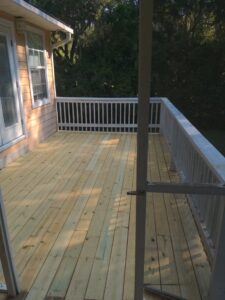
This is the first question almost every homeowner asks before building a deck here, and the honest answer depends on what you are willing to keep up with over the years, not just which one costs less upfront.
How Each Material Responds to Constant Moisture
Wood decking, even pressure-treated wood, absorbs moisture from Florida’s humidity and regular rain. Over time, that leads to warping, splitting, and boards that loosen at the fasteners if they are not sealed and maintained on a regular schedule. Composite decking is engineered specifically to resist moisture absorption, so it does not swell, warp, or rot the way wood does under the same conditions. Learn more about What Permits Are Actually Required to Build a Deck in St. Augustine?
What That Means for Long-Term Maintenance
Wood decking needs to be sealed or stained regularly to keep moisture out, usually every year or two in a climate like this, or the wood starts breaking down faster than expected. Composite decking skips most of that. It does not need sealing or staining, and a simple wash keeps it looking the way it did on day one. The trade off is that composite costs more upfront, while wood costs less to install but more over time in upkeep.
Material is one decision. Whether you actually need a permit before building is a separate question homeowners often get wrong, which the companion page on this pair covers. For full details on our deck building process, visit our deck building page, or see finished projects on our Google Business Profile.