Planning a home remodel in St. Augustine comes with plenty of big decisions and few affect your wallet and peace of mind more than the type of construction contract you sign. Whether you are updating a historic cottage downtown, renovating a coastal property near Vilano Beach, or remodeling a family home in St. Johns County, understanding how a fixed price vs cost plus contract Florida builders offer actually works is the first step toward protecting your budget.
Both contract structures are common across Northeast Florida, and neither is universally “good” or “bad.” Instead, each shifts financial risk in a different direction. Knowing how they operate and which one matches your specific project helps you choose the safest path forward before demolition begins.
What Is a Fixed-Price Contract?
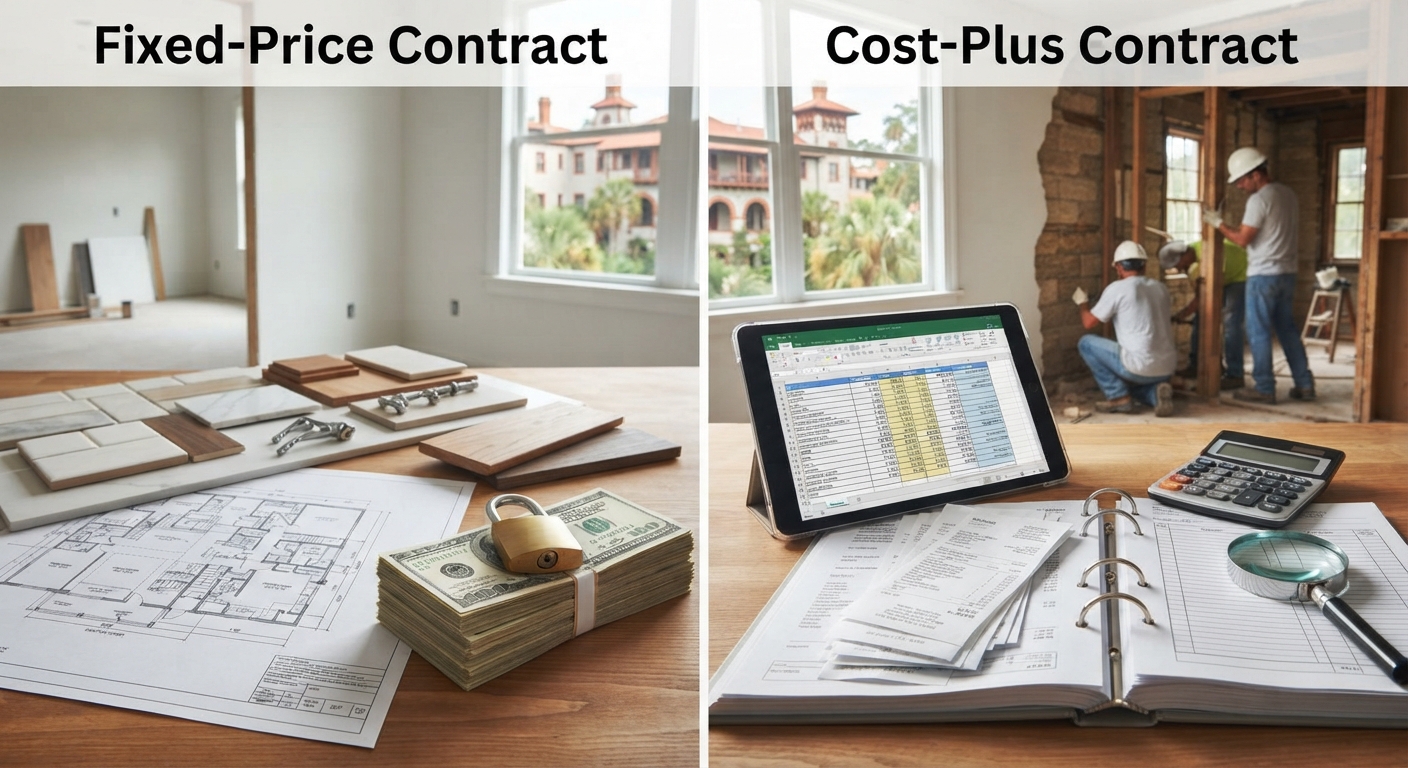
A fixed-price contract often called a lump-sum contract sets one agreed-upon total price for the entire remodeling scope before construction starts. Your contractor calculates labor, materials, subcontractor bids, permits, overhead, and profit upfront, then presents a single bottom-line figure.
How It Works in Practice
Under a fixed-price agreement, the contractor takes on the primary responsibility for estimating accuracy. If lumber prices tick upward mid-project or framing takes a few extra days than planned, the contractor absorbs that variance rather than passing it directly to you assuming the original project scope stays intact.
Advantages of Fixed-Price Contracts
- Predictable total investment: You know your final construction cost before work begins, making financing and personal budgeting much easier.
- Defined scope protection: Because pricing relies on detailed plans and specifications, expectations on finishes, materials, and deliverables are locked in early.
- Lower financial risk for homeowners: Cost overruns caused by builder miscalculations or minor labor inefficiencies stay on the contractor’s side of the ledger.
Potential Drawbacks to Watch For
- Built-in risk buffers: Because contractors carry the financial risk of unknowns, fixed-price bids often include contingency cushions to protect against unexpected price spikes.
- Requires complete upfront decisions: You must select tile, cabinetry, fixtures, and layouts before signing. If you are still undecided on finishes, getting an accurate fixed price is difficult.
- Less visibility into individual costs: You see the total package price rather than line-by-line receipts for every subcontractor invoice or material purchase.
What Is a Cost-Plus Contract?
A cost-plus contract works differently. Instead of paying one flat sum, you reimburse the contractor for the actual direct costs of the remodel materials, labor, equipment rentals, and subcontractors plus an agreed-upon fee for the builder’s overhead and profit. That fee is typically structured as either a fixed dollar amount or a percentage of total project costs.
How It Works in Practice
With a cost-plus model, the homeowner carries the direct financial risk of fluctuating expenses. If a plumbing rough-in goes smoothly and materials come in under estimate, you keep those savings. Conversely, if material costs rise or labor hours stretch longer than anticipated, your final bill increases accordingly.
Advantages of Cost-Plus Contracts
- Open-book transparency: You receive detailed accounting showing exact material invoices, labor hours, and subcontractor bills alongside the contractor’s management fee.
- Faster project kickoff: Work can often begin before every minor design detail or finish selection is finalized, which appeals to homeowners working on tight timelines.
- No inflated risk padding: Contractors do not need to pad estimates with large worst-case contingencies because you pay actual costs as they occur.
Potential Drawbacks to Watch For
- Uncertain final price: While your builder will provide an initial budget estimate, the true final cost is not guaranteed until the last invoice is paid.
- Financial exposure to surprises: St. Augustine homes, especially older properties near the historic district or salt-air coastal zones frequently hide behind-the-wall issues like outdated wiring, moisture damage, or non-standard framing. In a cost-plus agreement, uncovering those conditions directly raises your total cost.
- More active oversight required: Reviewing itemized expenses and tracking running budgets takes ongoing attention from the homeowner throughout construction.
Fixed Price vs Cost Plus Contract Florida: Key Differences
When comparing fixed price vs cost plus contract Florida remodeling agreements side by side, the differences come down to four core areas:
- Who carries budget risk: A fixed-price contract places estimating and cost-overrun risk on the contractor. A cost-plus contract places actual cost risk on the homeowner.
- Upfront planning requirements: Fixed-price contracts demand finalized architectural drawings and material selections before signing. Cost-plus contracts allow work to start while selections are still evolving.
- Cost transparency: Fixed-price agreements focus on the agreed total value of the finished project rather than internal markups. Cost-plus agreements provide full line-item visibility into direct project expenses.
- Final cost predictability: Fixed-price contracts give you a known ceiling for the defined scope, while cost-plus contracts leave the final number open until completion.
Which Contract Is Safer for a St. Augustine Remodel?
The “safer” contract depends on how well-defined your project is and how much financial uncertainty you are comfortable carrying.
When Fixed-Price Is the Safer Choice
For most residential kitchen remodels, bathroom renovations, and room additions with clear plans, a fixed-price contract is generally safer for homeowners. You protect yourself against unexpected labor overruns and supplier price increases, and you can compare bids apples-to-apples before committing. Working with an experienced general contractor St. Augustine homeowners trust ensures that every detail from St. Johns County permitting requirements to coastal-grade materials is accounted for in that upfront number.
When Cost-Plus Makes More Sense
A cost-plus contract can be a practical fit for large-scale custom builds, major structural restorations of historic St. Augustine homes where concealed conditions cannot be fully inspected beforehand, or projects where you plan to make ongoing design decisions during construction. If you choose cost-plus, a cost-plus with a Guaranteed Maximum Price (GMP) adds an extra layer of safety by capping the total amount you can be charged.
Frequently Asked Questions
Is a fixed-price or cost-plus contract more common for Florida home remodels?
Fixed-price contracts are more common for standard residential remodels such as kitchens, bathrooms, and additions because homeowners want predictable budgeting. Cost-plus contracts are more frequently used on high-end custom homes or complex historic renovations where the full scope cannot be locked down upfront.
Can a cost-plus contract end up costing less than a fixed-price contract?
Yes, it can. Because fixed-price bids often include contingency cushions to protect the builder against unforeseen price increases, a smooth cost-plus project with stable material costs and efficient labor can occasionally finish below what a fixed-price quote would have been. However, it also carries the risk of finishing higher.
Does Florida law require a specific contract type for residential remodeling?
Florida construction law does not mandate whether a homeowner and contractor use a fixed-price or cost-plus structure. Both are legal and widely used across the state, provided the agreement is in writing and includes required Florida statutory disclosures, such as lien law notices and construction defect provisions.
What is a Guaranteed Maximum Price (GMP) in a cost-plus contract?
A Guaranteed Maximum Price is a cap written into a cost-plus agreement that sets the highest amount the homeowner will pay for the defined project. You still pay actual costs plus the contractor’s fee, keeping any savings if the project comes in under budget, while the contractor absorbs costs that exceed the maximum cap.
How do I know which contract structure fits my St. Augustine home project?
If your plans, layouts, and finish selections are complete and budget certainty is your top priority, a fixed-price contract is usually the best fit. If you are renovating an older property with unknown structural conditions or want flexibility to evolve designs during construction, a cost-plus contract ideally with a GMP may serve you better.